


Battery-Backed Fast DC Charging
Fast charging, even
where the grid can't
keep up.
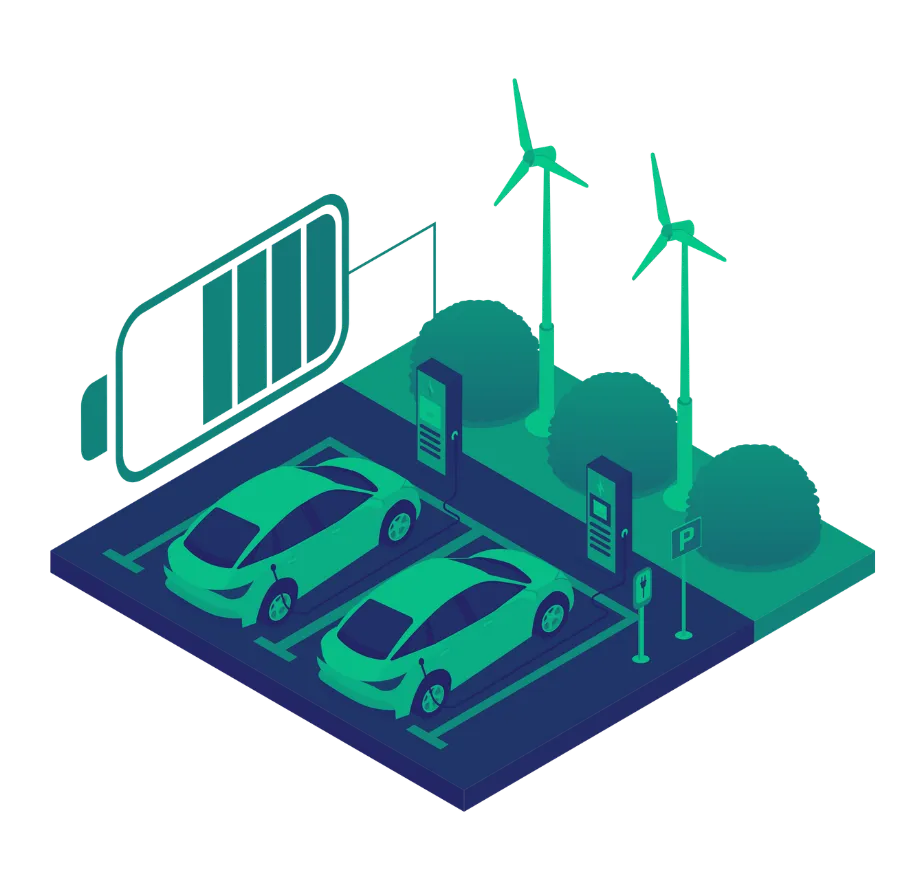
A battery energy storage system sits between your grid connection and your DC fast chargers. It draws power from the grid steadily, then releases it in fast bursts to vehicles. This means you can offer high-power charging using only a fraction of the grid capacity you'd otherwise need.
Contact us

The problem
Why high-power charging is hard to connect.
DC fast charging (DCFC) draws very high instantaneous power (a four-port 150 kW site can call for 600 kW^), but only in short, intermittent bursts. Grid infrastructure has to be built for that peak, even though average utilisation is a fraction of it.
Months+

Augmenting a connection to carry the peak means feeder and substation works, network studies and long queues. Months to years and real money, where capacity exists at all.
kVA
Network demand tariffs bill your maximum demand, not your average. A site averaging 600 kVA can spike well above that and it's the spike that sets your charge. Network charges can make up 50-70% of a charging site's electricity bill, per Evie Networks' submission to the Vic Parliamentary EV Inquiry.
0 ride-through
Grid-only DCFC has no fallback. A feeder fault or outage drops every port at once: sessions fail, SLAs slip and revenue stops.


The problem
The fix: a battery in the middle.
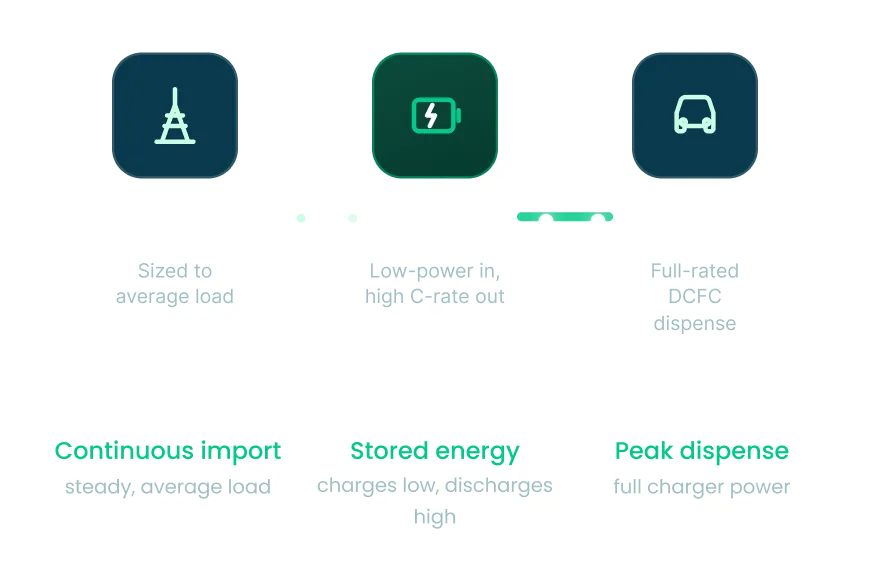
A battery energy storage system (BESS) is installed between the grid connection and the chargers. It charges continuously at a low, constant power the connection can supply, and discharges at a high C-rate to meet the chargers' instantaneous dispense demand.
Because the battery supplies the peak, the grid connection only has to cover average load, not peak dispense. Import and dispense power are decoupled. It is the principle of a header tank on a thin supply line: fill slowly and continuously, then deliver a flow rate the line alone never could.
Genuine high-power DCFC, delivered on a connection sized for the average, not the peak.
Contact us
Six reasons sites specify it.

Skip the grid upgrade
Put fast charging on a weak connection: depots, councils, regional corridors, retrofit sites and busy car parks, without augmenting the connection or joining the upgrade queue.
Because the battery carries the peaks, your connection only has to cover average load, often a fraction of the peak a grid-only site would need.
Cut demand & energy charges
The battery absorbs demand spikes, keeping grid import flat and cutting demand charges, then shifts import into off-peak windows under time-of-use tariffs (energy arbitrage).
A single steady import profile in place of the demand spikes that dominate a DCFC bill. Some networks also reward dispatchable discharge.
Ride-through & islanding
Configured for islanding, the battery keeps the chargers running through a grid outage. Runtime ≈ usable capacity ÷ average load: a 500 kWh battery at 50 kW holds about 10 hours.
Backup and high-power charging from one asset, with no separate standby generator on site.
Connection cost abatement
The battery replaces the network augmentation quote, not just defers it. Behind-the-meter buffering delivers the same power at the charger for typically 30–40% less than a grid upgrade, with no DNSP augmentation application to lodge or contest.
The capex stays on your side of the meter, as an asset you own, instead of a network cost you never get back.
Plug-and-play 3-phase upgrade
A drop-in upgrade on your existing 3-phase connection, delivered, connected and commissioned in months, not the years a network augmentation takes. No new feeders to trench, no queue to wait in.
Typical deployment in 2–4 months, against 18–36 months for a conventional connection upgrade.
Duty cycle favours LTO
High-power charging is hundreds of short, high-C bursts a day, not one long draw. LTO is built for exactly that: 20,000+ cycles at high C-rate versus roughly 4,000-5,000 for LFP carrying the same load.
In practice
Worked example:
sizing the battery.

Site: four 150 kW ports, 600 kW^ of dispense. Grid connection: 100 kW continuous, nowhere near the peak.

Cover the busy hour: the battery needs enough usable storage for a sudden surge: (150 kWh × ports) - (grid kW × 1 h) = 600 - 100 = 500 kWh. It also needs to discharge at up to 500 kW at that peak moment, not just hold the energy.

Keep it topped up: the connection only has to match average daily demand, so the battery recharges between sessions. It stays at 100 kW.
600 kW^ of charging from a 100 kW connection, sized to your busiest hour and day, not to the peak.
Illustrative figures, assuming all ports peak together for the full hour. 150 kWh is roughly an extended-range EV charged to 80% on a 200 kWh pack. Your sizing depends on how the site is actually used.
^A site averaging 600 kVA (=600KW if power factor is 1.0) can spike well above that and it's the spike that sets your charge.
^A site averaging 600 kVA (=600KW if power factor is 1.0) can spike well above that and it's the spike that sets your charge.
Is your site a fit?
Worth modelling if any of these apply.

Grid connection capped below required dispense power
Network augmentation quoted long-lead or high-capex
Demand tariff dominated by short charging peaks
Uptime or SLA exposure to feeder outages
If any apply, battery-backed charging is worth a look.
Why Arvio
More than a battery bolted on.
Plenty of suppliers will sell you a battery and a charger. Arvio engineers the battery as the heart of the system: sized to your site and built to hold rated power across heat, dust and distance, year after year.

Sized to your site
Matched to your charger count, demand profile and busiest day, so you are not designing around a fixed box or paying for capacity you will never use.

Built for the toughest conditions
Specified for the temperature range, ingress and exposure of real charging sites, not just bench conditions. It keeps working where others stop.

One battery, three jobs
Grid relief, lower bills and backup from a single battery: one clear outcome to plan around, not a catalogue to wade through.

Australian Made
Model it for your site.
Every connection, tariff and duty cycle is different. Tell us your grid capacity, the chargers
you want and how the site gets used, and we'll size the battery and show you the connection,
bill and uptime case. No spec-sheet maze, no oversized box: one clear answer for your site.
Talk to our team